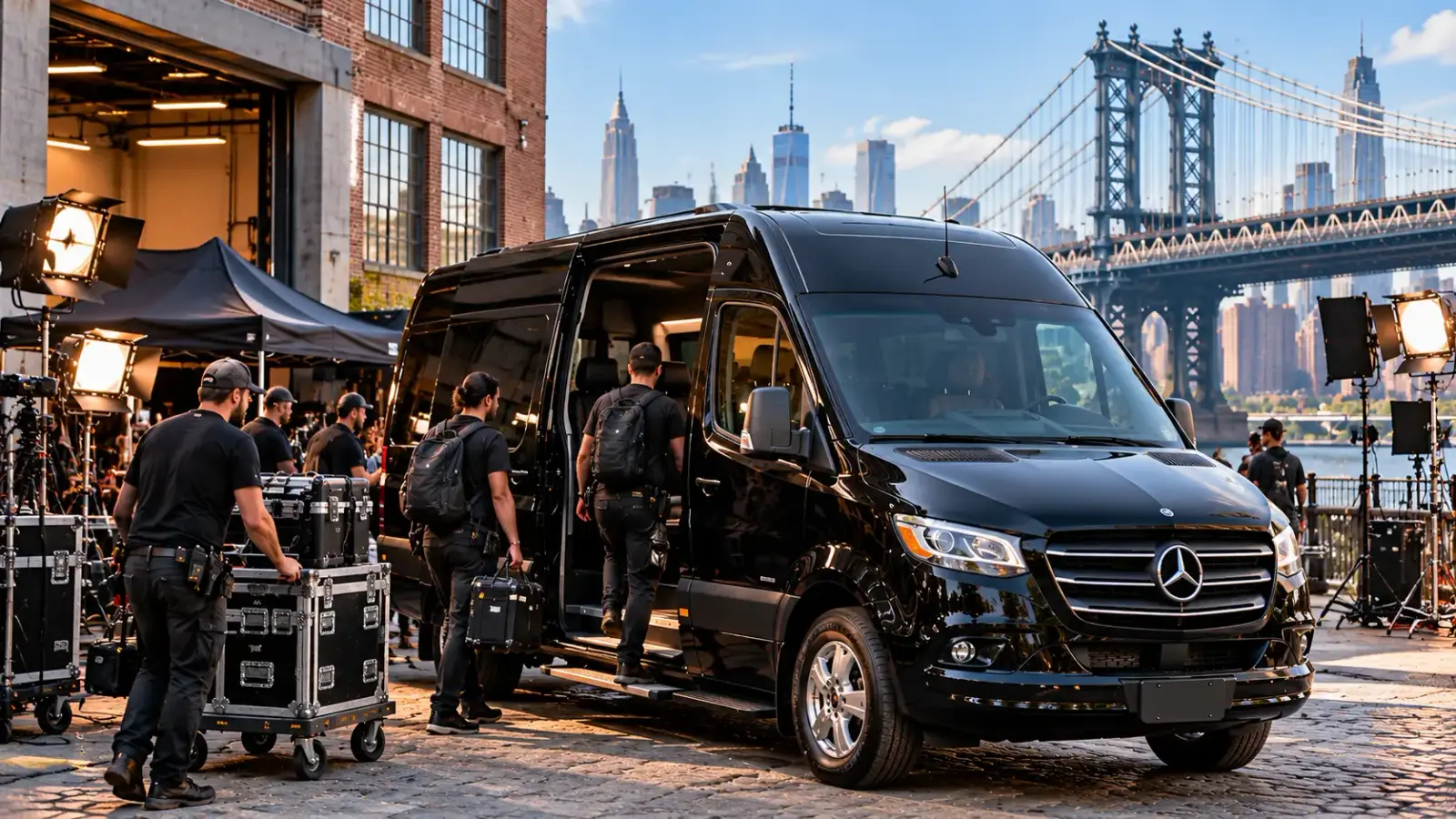
A film set does not run on "the van will be there around then." It runs on a call sheet — pre-call at 4:30, general call at 6, first shot at 8 — and every department's day is built backwards from those numbers. A shuttle that arrives twelve minutes late is not a late ride; it is hair and makeup starting late, a first shot pushed, and overtime arithmetic nobody budgeted for. That is why production transportation is a different discipline from ordinary group transportation, and why Brooklyn, one of New York's busiest production boroughs, needs operators who understand the discipline, not just the driving.
Brooklyn is no longer New York production's overflow borough; it is one of its centers. Steiner Studios anchors the Brooklyn Navy Yard. Broadway Stages anchors Greenpoint. And on any given week, location units are shooting on Park Slope and Fort Greene brownstone blocks, along the DUMBO and Williamsburg waterfronts, in Red Hook warehouses and around Industry City. Every one of those productions has the same daily problem: moving the right people, in the right order, between hotels, basecamp, holding and set — quietly, on time, and again tomorrow. This guide is about how that problem is solved properly with Sprinter vans, and what a production should expect — and demand — from the company solving it.
Book nowTable of Contents
- Quick Answer
- Who a Production Shuttle Actually Moves
- The Six Transportation Jobs on a Brooklyn Shoot
- How the Shoot Day Runs
- The Brooklyn Production Map We Drive
- Which Vehicle Fits Which Production Job
- What to Tell Us When You Book
- How Pricing Works
- Frequently Asked Questions
- Related Reading
Quick Answer
Iona Sprinter provides chauffeured Sprinter van transportation for film crews in Brooklyn, coordinated around the production's call sheet. Mercedes-Benz Sprinter vans seating 11–14 passengers move crew departments, background performers and production staff between hotels, basecamp, holding and set in continuous shuttle loops or scheduled runs; an Executive Sprinter, sedan or SUV moves principal cast, directors and producers separately and discreetly. One production contact, chauffeurs briefed on the day's plan before the first pickup, 24/7 coverage for early calls, night shoots and late wraps — serving Steiner Studios, Broadway Stages and location shoots across Brooklyn, with airport arrivals at JFK, LaGuardia and Newark. Pricing is quoted per production and confirmed in writing; there are no published rates.
Who a Production Shuttle Actually Moves
"Film crew" is four different transportation jobs wearing one name. A well-run production separates them, because each group moves on a different clock and a different standard of care:
Crew Departments
Camera, grip, electric, art department, hair, makeup, wardrobe, sound and the PA team — the largest daily movement. Department groups travel together with their personal kit, on the shuttle loop between basecamp, holding and set, from pre-call to wrap.
Background Performers
BG days are volume days: dozens of performers moving from check-in and holding to set in waves, and back again at wrap — often in costume changes and tight turnarounds. This is where multiple Sprinters on a timed loop earn their keep.
Principal Cast, Directors & Producers
First team moves separately: a dedicated Executive Sprinter, sedan or SUV, on the cast's own call times, with a chauffeur who understands set etiquette and discretion. No shared rides, no waiting on a loop, no attention drawn at the curb.
Production Office, Agency & Clients
Producers, executives, network and agency visitors, and commercial clients moving between the production office, set visits, hotels and airports — plus tech scouts and location teams in pre-production, before a single frame is shot.
The Six Transportation Jobs on a Brooklyn Shoot
1. Hotel-to-basecamp morning runs
The day starts before the call sheet says it does. Crew staying at Brooklyn and Manhattan hotels, out-of-town department heads and visiting cast need to be at basecamp before general call — which, on an early day, means pickups in the dark, in a fixed order, with zero tolerance for a missed stop. Morning runs are scheduled backwards from call time, with the chauffeur briefed on every pickup in advance.
2. Basecamp-to-set shuttle loops
The core production movement: continuous circulation between basecamp, holding, hair and makeup, and the set itself. On a stage day at Steiner or Broadway Stages the distances are short but constant; on a location day in Fort Greene or Red Hook, the loop is the production's circulatory system — people flow to set as scenes demand, all day, without the unit ever waiting on transportation.
3. Company moves
When the unit changes location mid-day — a morning on a Park Slope block, an afternoon on the DUMBO waterfront — the whole company moves at once, and the move is timed to the shooting schedule, not to traffic's convenience. Company moves are planned with the AD department and the transportation captain in advance: who goes first, who wraps the old location, and in what order vehicles arrive at the new one, within the location's permitted parking and the neighborhood's real staging options.
4. Tech scouts and pre-production
Before the shoot, the scouting party — director, DP, production designer, location manager, producers — spends long days moving between candidate locations across Brooklyn and beyond. A Sprinter is the natural scout vehicle: the whole party in one vehicle, reviewing the route and the previous location while traveling to the next, with room for boards, kit and coffee. Scout days are booked by the hour, with the chauffeur holding position at each stop.
5. Airport arrivals for cast and executives
Cast flying in for a Brooklyn shoot, executives arriving for a set visit, a director landing the night before a scout: flight-tracked pickups at JFK, LaGuardia and Newark, with meet and greet on request and a direct run to the Brooklyn hotel or straight to basecamp. Our airport transfer service page covers how pickups at JFK, LaGuardia and Newark work.
6. Wrap returns — and the second unit
Wrap is a movement too: tired crews back to basecamp, hotels and park-and-rides after a 12- or 14-hour day, background performers released in waves, and the last vehicles out after the set is struck. Night shoots and split days run the same system in the dark. Splinter and second units working apart from the main unit get their own dedicated vehicle and chauffeur, on their own call sheet.
How the Shoot Day Runs
Productions do not need a sales pitch; they need to know the working method. Ours is built to slot into the production's own system:
1. The call sheet comes to us
Your transportation captain, coordinator or AD department sends the call sheet — or, for scouts and smaller shoots, simply the day's key information: call times, basecamp and set addresses, headcounts per move, hotel pickups, and the one contact we report to. The shuttle plan is built from that document, not from a generic booking form.
2. Chauffeurs are briefed before the day
Every chauffeur receives the plan before the shoot day: pickup order, staging points, gate and access instructions for studio lots, the production contact, and the day's known pinch points. Vehicle and chauffeur details go to your designated production contact, so the AD department always knows exactly who is rolling and when.
3. The day runs on the loop — and adapts
Morning runs, basecamp loops, set runs and meal-break moves run to the plan. When the day changes — a scene runs long, a location is added, wrap moves — one call or message to your Iona Sprinter contact re-times the plan.
4. Wrap, returns, and tomorrow
At wrap, returns run in the production's release order until the last person is back. For multi-day and episodic work, the same production contact carries across the whole run, so the plan does not have to be re-explained each day.
Working with your transportation department — not around it
On larger productions, Iona Sprinter works under the direction of the transportation coordinator and captain: our vehicles take the people-moves they assign — crew, cast, BG and office runs — while the production's own trucks handle equipment, picture cars and unit gear. On independent films, commercials, branded content and photo shoots without a full transportation department, we effectively become it for passenger movement: one operator who plans the shuttles, staffs the hours and answers for the schedule. Either way, set etiquette is understood and observed — vehicles stage where the location department directs, engines and noise are kept down near a rolling set, and chauffeurs take instruction from the ADs on the ground.
Discretion is part of the service
Productions work under confidentiality, and transportation sees everything: casting surprises, locations before announcement, schedules, faces. Iona Sprinter's service is private and discreet as standard. CHAUFFEUR_CONFIDENTIALITY_POLICY_TBD. If your production office requires vendor NDAs, raise it when you book: NDA_POLICY_TBD.
An honest note about equipment
A passenger Sprinter moves people — beautifully. Crew travel with their personal bags and small personal kit in the luggage space, and that is the right use of the vehicle. Camera carts, grip and electric packages, lighting rigs and set pieces belong on the production's trucks, and a crew van is not the place for a full equipment package. What we guarantee is the half of the logistics that is ours: the people arrive, together and on call, every time the schedule says they should.
The Brooklyn Production Map We Drive
Brooklyn production geography is specific, and each area asks something different of a shuttle operator:
- Steiner Studios, Brooklyn Navy Yard. The borough's production anchor, inside the secured, gated Navy Yard. Gate access, check-in and internal staging follow the lot's and the production's instructions; crews are collected and delivered at the production's designated points, and shuttle staging respects the Navy Yard's own traffic and security routines.
- Broadway Stages, Greenpoint. Stage work in the north Brooklyn industrial grid — straightforward approaches, but call-time traffic towards the bridges builds early; morning runs are timed for it.
- Location work — Park Slope, Fort Greene, Clinton Hill. Brownstone Brooklyn is some of the most-filmed residential streetscape in America, and the most constrained: permitted parking is posted and precious, basecamps sit blocks from set, and the shuttle loop between them runs on residential streets where staging quietly and exactly where directed is the whole job.
- DUMBO, Williamsburg and the waterfront. High-demand blocks, cobblestones in DUMBO, and bridge-approach traffic in both directions. Pickup points are chosen for legal standing, not just proximity.
- Red Hook, Industry City and Sunset Park. Warehouse and studio space, wider streets, longer loops — and productions that lean on shuttle circulation between scattered units and stages.
- Coney Island and South Brooklyn. Boardwalk and amusement-district shoots, seasonal crowds, and long returns at wrap — planned with the same call-sheet discipline as a stage day.
Underneath all of it is the advantage of a Brooklyn-based operator: Iona Sprinter is based on Bay 43rd Street in Brooklyn, and our Sprinter van service in Brooklyn page covers the neighborhoods we serve.
Which Vehicle Fits Which Production Job
| Vehicle | Capacity | The Production Jobs It Fits |
|---|---|---|
| Regular Sprinter | 11–14 passengers | Crew department shuttles, background performer waves, basecamp-to-set loops, company moves, scout parties |
| Executive Sprinter | 11–14 passengers, reclining seats & tables | Principal cast and creatives, director/producer runs, agency and client set visits, executives working en route |
| Luxury Sedan / SUV | Sedan 1–4 / SUV 5–7 passengers | Individual cast pickups, discreet single-passenger runs, airport arrivals for executives |
| Multi-Vehicle Plan | Multiple Sprinters, mini coaches (24/36) or coach bus (56) | Large BG days, full company moves, episodic blocks, productions moving several departments at once |
Why a Sprinter, specifically, became the production industry's standard crew vehicle: the standing-height cabin means crew board and settle fast and step out ready to work, not folded out of a low minivan after an hour; forward-facing individual seats with belts suit early calls and late wraps alike; the cabin is quiet enough for the calls, messages and schedule-checking that fill every production journey; SPRINTER_CHARGING_TBD; and a black Sprinter is discreet at a location in a way a liveried shuttle bus never is. It is, in short, the largest group of people that can be moved through Brooklyn streets, into a basecamp and up to a set, without the vehicle itself becoming the day's logistics problem.
What to Tell Us When You Book
The most useful first message from a production office contains:
- Production type and working title (or simply "commercial", "episodic", "feature", "photo shoot")
- Shoot dates — and whether it is a single day, a block, or a recurring run
- Call times: pre-call, general call, and the expected wrap pattern (including night or split days)
- Basecamp, holding, set and hotel addresses — as many as are confirmed
- Headcounts per movement: crew, background, cast, office — and who travels separately
- Your single production contact for transportation (captain, coordinator, AD or PA)
- Any access requirements: studio gate lists, location permits, staging instructions
- Confidentiality or NDA requirements, if your production office uses them
Dates still penciled and locations still being scouted are normal — productions book transportation while the schedule is still moving, and the plan is built to move with it.
How Pricing Works
Iona Sprinter does not publish rates, and film work is the clearest example of why: no two shoot days have the same shape. Production transportation is quoted individually, per production, and confirmed in writing before the first day — one written quote your production office and accounting department can work from. CONSOLIDATED_INVOICE_TBD
What a quote depends on is straightforward: the number and type of vehicles; the hours involved — standby shuttle days are structured differently from point-to-point runs; call and wrap times, including early, night and split-day patterns; the number of shoot days, with multi-day and episodic blocks quoted as a single engagement; and any multi-vehicle scheduling for BG-heavy days or company moves. Tell us the shape of the production — the quote is built from it, and the figure confirmed in writing is the figure the production is invoiced.